The Invisible Layer of Fluency: Understanding Japanese Pitch Accent
When Japanese sounds natural, it is not only because the grammar or word choice is correct.
Each word carries a characteristic phonological contour: a rise, a drop, or a sustained high pitch that
native speakers hear instantly, even when learners are almost never taught to notice it.
This guide
turns those hidden contours into something visible and concrete, starting with some basic terminology, the
four central pitch
patterns and ending with how they behave inside real sentences.
The Foundation: Morae and Pitch
Before we dive into the four different pitch patterns, we have to clarify how Japanese measures sound. If you are coming from English, you are used to a stress-accent language built on syllables. Stress-accent means that when you pronounce a word, you emphasize certain syllables by making them louder, longer and higher in pitch. Japanese, however, is a pitch-accent language built on steady, rhythmic beats called morae (拍).
Morae vs. Syllables
A mora is the fundamental timing unit of sound and rhythm in Japanese. To understand the difference, let's look at the word 東京. An English speaker naturally parses this as two syllables: とう and きょう. But a Japanese speaker processes it as exactly four equally-spaced beats: と-う-きょ-う.
When counting morae, there are two important rules to remember:
- Small combination characters (like きょ, しゃ, じょ) only count as one mora, not two.
- ん, っ and the long vowel mark 'ー' also count as a single mora respectively.
When a Japanese word is accented, it features a distinct musical drop in pitch between exactly two consecutive morae. Specifically, an accented word has exactly one accent kernel (アクセント核). Popular dictionaries like 大辞泉 or 大辞林 use numbers to indicate the exact position of this accent kernel within the word:
- [0] means there is no accent kernel, i.e. the word is flat and does not drop.
- [1] the first mora is accented.
- [2] the second mora is accented and so forth.
akusento simplifies this notation standard by directly highlighting accented morae within text with this red pitch drop symbol: ア. That way you do not need to count morae manually and directly know where the drop is supposed to happen.
Visualizing the Pitch
To see clearly how an accent kernel works in practice, we can look at an actual pitch analysis graph. Below is a fundamental frequency (F0) tracking curve from a speech analysis software called Praat. It plots the musical pitch of a native speaker's voice in Hertz (Hz) over time as it moves across each beat (mora).
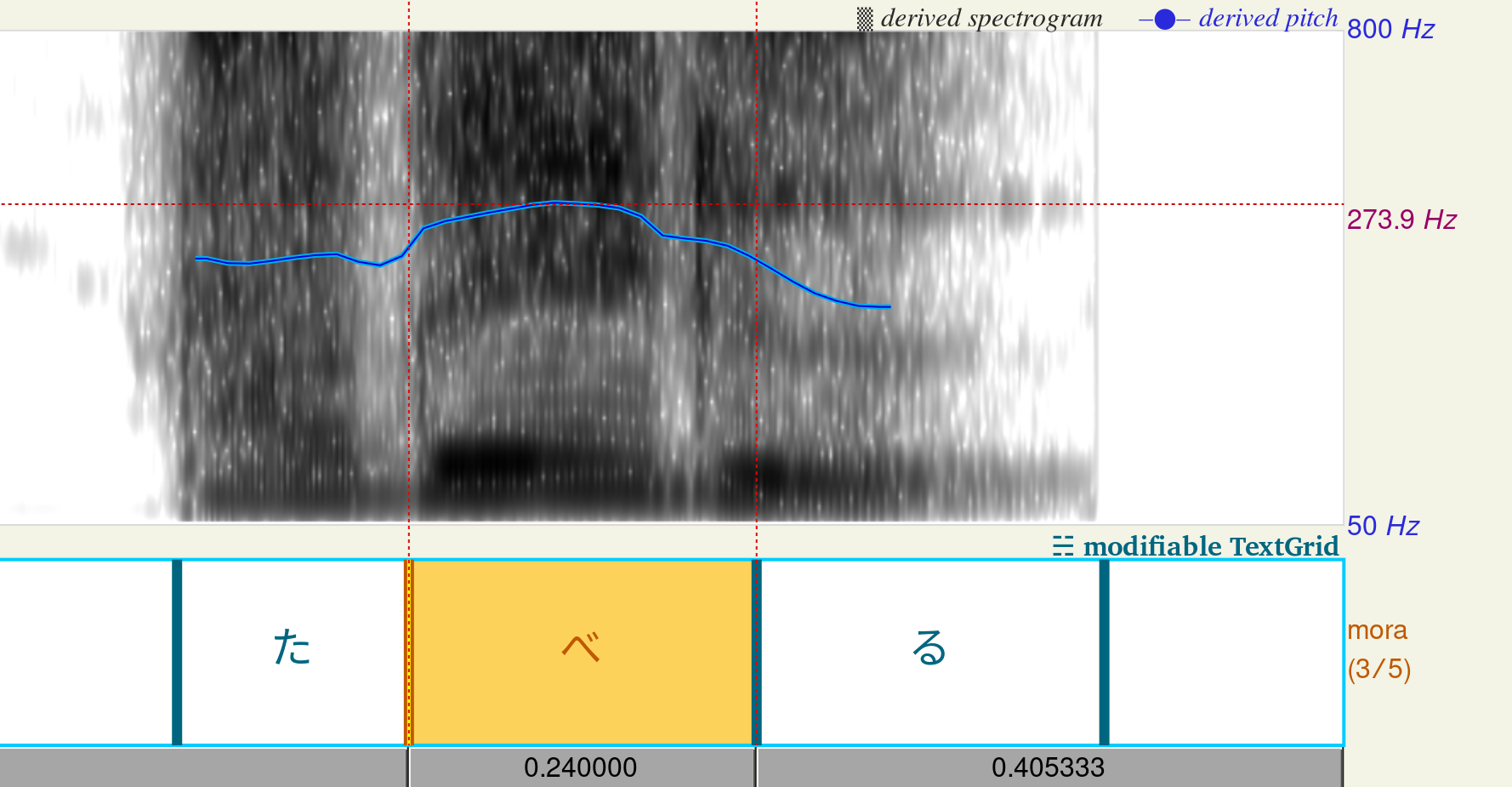
When you break down this Hz graph using morae, the mechanics of the accent kernel become very simple:
- The High Mora (Peak Hz): The accented mora is the final beat held at a high musical frequency (a higher Hz value).
- The Accent Kernel (The Drop): This is the exact boundary line right after this high mora. It acts like a cliff.
- The Low Morae (Dropped Hz): Immediately after crossing that boundary, your vocal cords vibrate slower. The pitch plummets to a lower frequency (a lower Hz value) for the very next mora and stays low until the end of the word.
The Four Core Pitch Patterns
In Standard Tokyo Japanese (標準語) all words can be categorized into into the following four distinct pitch accent patterns:
平板 (Heiban - Flat)
Starts low on the first mora, rises on the second, and stays high. The pitch does not drop when a particle (like に) is attached.
頭高 (Atamadaka - Head-high)
Starts high on the first mora, then immediately drops on the second mora and stays low. Particles remain low.
中高 (Nakadaka - Middle-high)
Starts low, rises, and then drops somewhere in the middle of the word. Particles remain low.
尾高 (Odaka - Tail-high)
Starts low, rises, and stays high until the last mora of the word. The pitch drops immediately after the word, forcing the attached particle low.
Accent Phrases: How Words Group Together
So far, we have looked at pitch accent as if every word were pronounced in isolation. Real Japanese is different. Words attach to particles, modifiers attach to nouns, verbs attach to auxiliaries, and several written words may be pronounced as one prosodic unit. This unit is called an accent phrase, or AP (アクセント句).
What is an accent phrase?
An accent phrase is a short stretch of speech pronounced with one continuous pitch contour. In practical terms, it can contain zero or one main accent drop. If another strong drop would appear, Japanese usually starts a new accent phrase instead.
This is why particles often belong to the word before them, while a new content word often starts a new phrase:
- 雨が can behave as one accent phrase.
- 本を can behave as one accent phrase.
-
本 を ・読 む consists of two accent phrases, each with a single accent drop.
How akusento displays accent phrases
In akusento, the red mark shows the accent drop, while the centered dot ・ shows an accent phrase boundary. The dot is not part of the Japanese spelling, and it does not always mean that you should pause. It simply means that the pitch contour resets there.
For example, a sentence may be displayed like this:
雨が・やんだら・出かけようと・思って・いたのに
Each section between the dots is one accent phrase. Some phrases have a visible red pitch drop. Others are flat and have no visible drop at all.
Why accent phrases matter
Accent phrases are important because sentence-level pitch accent is not just a list of word accents. A word may lose its original accent, attach to a particle, merge into a compound, or split away from a neighboring word depending on grammar and context.
This is also why dictionary pitch numbers are only a starting point. A dictionary can tell you the isolated accent of a word, but it cannot always tell you how that word behaves inside a full sentence. akusento uses accent phrases to show the sentence-level rhythm that emerges after particles, compounds, conjugations, and deaccenting rules have been applied.
The accent phrase boundary marker ・ should be read as a guide to pitch grouping, not as punctuation. In natural speech, some boundaries are very light, while others may coincide with an actual pause or comma. Accent phrase boundaries are also not always completely definitive: different speakers, speech speeds, emphasis, and analysis traditions may group the same sentence slightly differently. akusento shows a context-aware prediction of one natural reading, not the only possible pronunciation.
Verb pitch accent: the Heiban/Kifuku shortcut
Verb pitch accent looks complicated at first because every conjugation seems to have its own contour. But for most practical purposes, verbs are much simpler than nouns. You do not need to memorize four separate pitch patterns for every form. You mainly need to know whether the dictionary form belongs to one of two groups: Heiban or Kifuku.
The two verb groups
Heiban verbs are flat in their dictionary form. They have no accent drop, and their pitch usually stays high into whatever follows. A typical example is 遊ぶ.
Kifuku verbs are accented. Their dictionary form contains a pitch drop, usually on the
second to last mora of the verb: 食べる,
Heiban verbs
Heiban verbs begin flat, but some endings introduce a new accent of their own. The base verb does not carry an accent kernel into the conjugation.
- Baseあそぶ
- Politeあそびます
- Past / te-formあそんだ / あそんで
- Negative pastあそばなかった
- Desiderativeあそびたい
- Hypotheticalあそべば
- Negative imperativeあそぶな
Kifuku verbs
Kifuku verbs already have a drop in the dictionary form. Depending on the ending, that original drop may be overwritten, preserved, or shifted left.
- Baseたべる
- Politeたべます
- Negativeたべない
- Past / te-formたべた / たべて
- Desiderativeたべたい
- Passiveたべられる
- Hypotheticalたべれば
The main rule: endings either add, overwrite, or shift the accent
Most verb conjugation rules fall into three useful patterns:
- The ending adds its own accent. This happens with endings like 〜ます, 〜たい, and 〜よう. The drop appears inside the attached ending: あそびます, たべます.
- The ending is accentless. For Heiban verbs, this often keeps the whole form flat: 遊んで. For Kifuku verbs, the accent often shifts one to the left: たべて.
- The ending overwrites the base accent. Some endings replace the original Kifuku drop with a new drop in the auxiliary: たべられる, たべさせる.
| Form | Heiban example | Kifuku example | What happens |
|---|---|---|---|
| 〜ます | あそびます | たべます | The polite ending carries the accent. |
| 〜ない | あそばない | たべない | Kifuku verbs drop between the stem and ない. |
| 〜た / 〜て | あそんだ / あそんで | たべた / たべて | Kifuku verbs shift the drop to the third-to-last mora. |
| 〜たい | あそびたい | たべたい | The たい ending carries the accent. |
| 〜ば / 〜れば | あそべば | たべれば | The drop lands on the final mora of the verb stem. |
| Negative imperative | あそぶな | たべるな | Heiban verbs add a drop; Kifuku verbs keep the base drop. |
Useful guessing heuristics
These are not absolute laws, but they are good shortcuts when you do not know whether a verb is Heiban or Kifuku:
- Two-mora verbs ending in 〜つ are Kifuku:
待 つ立 つ勝 つ. - Most 〜ぶ verbs are Heiban: 遊ぶ, 飛ぶ, 運ぶ, 学ぶ. Common exceptions that are actually Kifuku include 選ぶ, 叫ぶ, and 喜ぶ.
- Many three-mora verbs with an い-row mora in the middle are Kifuku: 降りる, 過ぎる, 閉じる.
- Transitive and intransitive verb pairs usually belong to the same pitch group: 並ぶ / 並べる, 返る / 返す, 降りる / 降ろす.
- Compound verbs tend to be Kifuku:
分 かり合 う , 走りまわる.
Advanced chains: 〜ている, contraction, and polite forms
Longer verb chains behave like accent phrases built from multiple pieces. The most important example is 〜ている. In careful speech, this can still be heard as verb + て + いる, but in ordinary speech it often contracts to 〜てる. The pitch pattern depends first on whether the original verb is Heiban or Kifuku.
In the pitch examples below, ・ marks an accent-phrase boundary only where the verb-side contour and auxiliary-side contour are being treated separately. It is not part of the spelling, and it should not be read as a mandatory break after every て.
| Base type | Full form | Contracted form | Pitch behavior |
|---|---|---|---|
| Heiban | している | してる | している, してる. |
| Kifuku | みている | みてる | みている, みてる. |
Polite forms add another layer. The polite auxiliary 〜ます has its own accent behavior, so forms like しています and みています are not simply “flat” or “accented” as whole words. They are chains where more than one pitch event may be possible.
| Base type | Form | Typical pitch behavior |
|---|---|---|
| Heiban | しています | しています |
| Heiban | していません | していません |
| Heiban | していました | していました |
| Kifuku | みています | みて・います |
| Kifuku | みていません | みて・いません |
| Kifuku | みていました | みて・いました |
Contracted polite forms behave similarly: してます, してません, してました, and みて・ます, みて・ません, みて・ました.
In normal speech, the second drop in these chains is often significantly reduced, especially when the phrase ends there. But when something attaches after the polite form, such as 〜でした or 〜ので, the later auxiliary accent often becomes more noticeable: みて・ませんでした.
This is why full-sentence pitch accent cannot be solved by looking up the dictionary form alone. The parser has to decide how the base verb, the 〜ている chain, contraction, politeness, negation, and following material interact inside one accent phrase.
The Pitch of Compound Nouns
When two separate nouns combine to form a single compound noun (複合名詞), they rarely keep their original, isolated pitch patterns. Instead, they fuse together into a single accent phrase. To achieve this, one of the words will typically surrender its accent to create a brand new, unified pitch contour.
The akusento parser handles this by categorizing noun suffixes into five primary compounding cases.
1. 後部一型 (Rear-start Pattern)
In this pattern, the pitch drop occurs on first mora of the suffix (the rear word). No matter how long the first word is, the pitch will stay high until it crosses the boundary and hits that first beat of the second word.
Example: When a word attaches to the suffix 〜確認 , the pitch drop is placed on the か. For example 安全 then compounds like this: 安全確認.
2. 前部末型 (Front-end Pattern)
In this pattern, the pitch drop occurs on the final mora of the first (front) word, dropping exactly at the boundary before the suffix begins.
Example: The suffix 〜税 forces the pitch drop to occur on the mora immediately before it. This turns 消費 into 消費税.
3. 後部保存型 (Rear-Preserving Pattern)
Sometimes the suffix does not change its pitch, forcing the entire compound to adopt the original pitch pattern of the suffix itself. This usually happens when the suffix is a Nakadaka word.
Example: The word 委員会 keeps its pitch drop on the second い regardless of what attaches to the front of it. This means 教育委員会 is pronounced 教育委員会.
4. 平板型 (Heiban Pattern)
The entire compound noun becomes completely flat, wiping out any accent kernels that may have existed in the original words.
Example: Attaching suffixes like 〜化 forces the new compound to become entirely unaccented. For example, 機械化 becomes 機械化.
5. 尾高型 (Odaka Pattern)
The pitch drop is pushed to the very end of the compound word. The pitch stays high throughout the entire compound but drops immediately after the last mora, forcing any attached grammatical particle low.
Example: The counter suffix 〜目 frequently triggers this pattern. For example, 一番目 followed by the particle は is pronounced 一番目は.
Collision Repair: The Shifting Pitch Drop
Rules in Japanese phonology are usally consistent, but they occasionally collide with physical pronunciation constraints. This is especially true for the Front-end Pattern (前部末型).
Remember that in the Front-end Pattern, the pitch is supposed to drop exactly at the boundary between the two words. However, a pitch drop cannot occur on a "special mora" (特殊拍), such as the syllabic nasal ん, the small pause っ, a long vowel line ー or the second half of a diphthong (like the い in けい).
When the word boundary lands directly on one of these "illegal" beats, the parser automatically steps backward and shifts the pitch drop one mora earlier to fix the collision.
- Nasal collision: 住民税. The suffix 〜税 normally forces a pitch drop directly before it. But 住民 ends in ん, which is an illegal spot. The parser shifts the pitch drop back to the み → 住民税.
- Long vowel collision: 指定席. 〜席 creates a pitch drop before it, but 指定 ends with い, which is part of the long vowel (てい). The pitch drop shifts back to the て → 指定席.
When Words Don't Fuse (Non-Compounding)
It is important to note that not all noun pairings merge into a single accent phrase. Depending on their grammatical relationship, many combinations resist compounding. Instead of fusing, they remain as two distinct accent phrases, preserving their original, separate pitch patterns. This typically happens in a few specific scenarios:
- Subject vs. Object (Suru-verbs): If the second word is an action (a suru-verb) and the first word is the subject performing it, they do not compound. For instance, 社長辞任 (The president resigns). However, if the first word is the object receiving the action, they fuse into one phrase: 結果発表 (Announcing the results).
- Action Exceptions: Certain action words refuse to compound even when they act on an object. Suffixes like 〜禁止 or 〜中止 are an example of this. If you say 駐車禁止 or 原因不明, they are treated as two syntactically separate ideas.
Why Standard Dictionaries Fail at Sentence-Level Pitch
Looking up words in a standard dictionary is fine for flashcards and quick lookups, but Japanese isn't spoken in isolated words. Pitch accent is highly dynamic and context-dependent. When a word is conjugated, attached to particles, used within compounds or set phrases, the accent drop often shifts or even disappears entirely through deaccenting. Sometimes one word can even have multiple acceptable pitch patterns. In most cases these dynamic changes are not random quirks of the language. They stem from the underlying phonological patterns and grammatical rules that can be learned and applied quite effectively.
To truly understand how pitch accent works within a full sentence and how the sentence is supposed to sound, you need context-aware parsing that is able to apply and transparently explain these rules. Consider the following example:「雨がやんだら出かけようと思っていたのに、結局そのまま本を読み続けてしまった。」In the parsing example below, you can click on any word to see its pitch accent information and other important metadata. Notice how the pitch flows and shifts in this complex sentence compared to just focusing on isolated vocabulary? Also take a look at the small ・ marks: these show where akusento divides the sentence into accent phrases, not where Japanese spelling has punctuation.
Frequently Asked Questions
Why does pitch accent matter if people can understand me from context?
Context often helps people to understand what you mean, but it does not make pitch accent irrelevant. Incorrect pitch can make otherwise correct Japanese sound unnatural, harder to follow, or occasionally ambiguous. The goal is not perfection for its own sake; it is to make the rhythm of your Japanese easier for native speakers to process.
What is the difference between pitch accent and intonation?
Pitch accent is the internal high/low sound structure of individual words, which determines meaning. Intonation is the rise and fall of the voice over an entire sentence to convey emotion or a question.
Do I have to memorize the pitch for all conjugations of every verb and adjective?
No! You only need to know if the dictionary form of the verb/adjective is flat (Heiban) or accented (Kifuku). Once you remember this, every conjugation, from the past tense to the negative form, follows strict and predictable rules.
How do I find the pitch accent of a whole sentence or phrase?
Standard dictionaries only show isolated words. To see how pitch changes within a sentence when particles and conjugations are added, you need a parser like akusento that analyzes sentence context.
Does akusento teach regional dialects?
No, akusento focuses exclusively on Standard Tokyo Japanese (標準語). This is the standard pronunciation used in national broadcasting, news, and a majority of media like Anime or J-Dramas. Regional dialects, such as Kansai-ben, use entirely different pitch accent systems.